WPL 2027 auction: less than 24 hours to go, in five numbers and five questions
27 October 2026
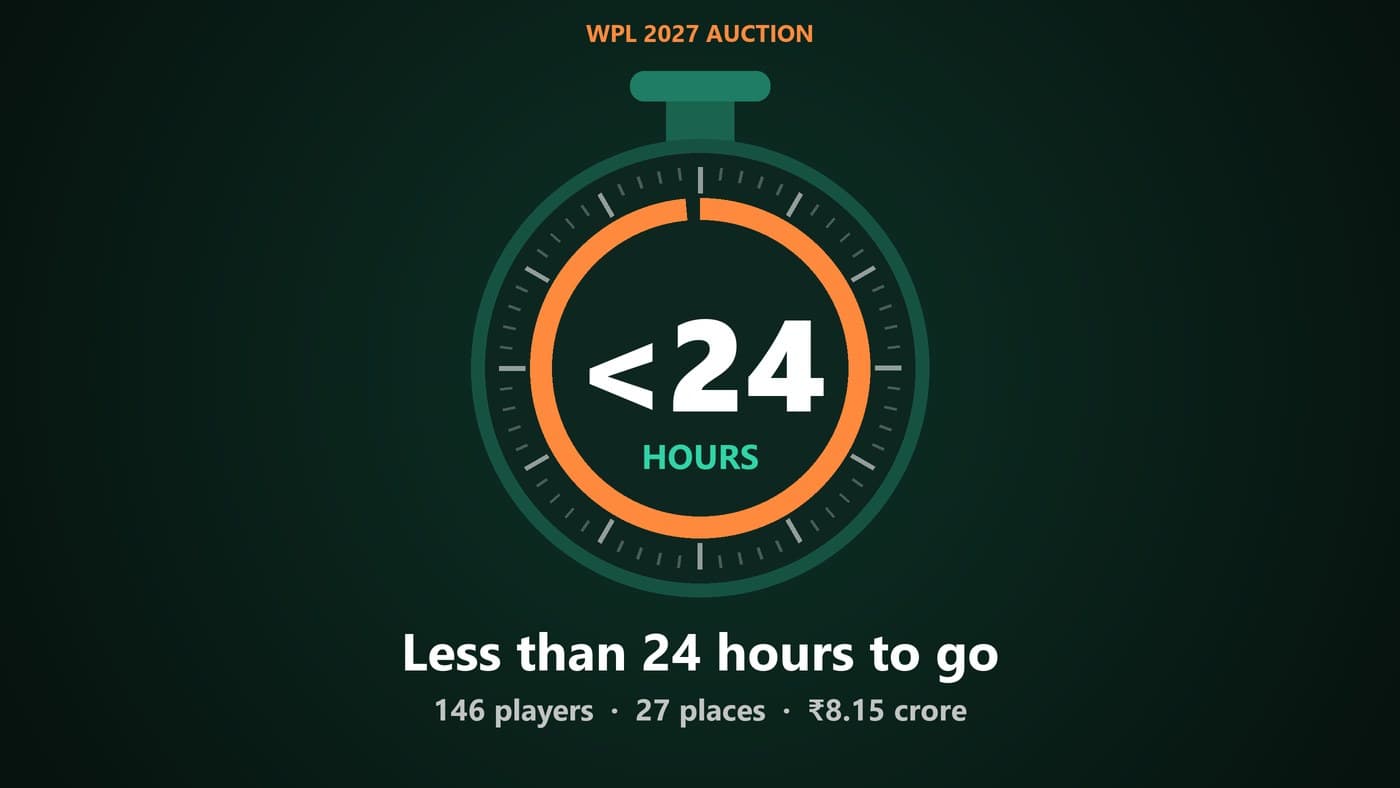
Less than a day from now, five rooms' worth of ambition will be squeezed into one. The Women's Premier League auction opens in Kochi on 28 October, and the numbers that decide it are small enough to hold in your head. This is a pre-match read: five numbers, five questions, and how to follow the night without losing the thread.
Everything below comes from the league's published lists and from CricOptics's own tables. The forecast references are a simulation, labelled as one. Nobody outside the five franchises knows what they will actually do.
Five numbers that explain the night
146. That is the pool: 146 players in 28 sets. Most of them will not be sold.
27. That is how many places there are to fill across all five teams. Seven are for overseas players. Do the sum and about four in five of the pool goes home without a contract.
₹8.15 crore. That is every team's remaining money added together. For scale, the 63 players already retained cost ₹66.85 crore. The auction is about an eighth of the money the league has already committed.
₹3.75 crore. UP Warriorz alone hold that much, with eight places to fill and three of them overseas. The other four teams have roughly a crore each: Gujarat Giants ₹1.25 crore, Royal Challengers Bengaluru ₹1.15 crore, Delhi Capitals ₹1.10 crore and Mumbai Indians ₹0.90 crore.
₹3.4 crore. The most the league has ever paid for a player, for Smriti Mandhana in 2023. With a purse like this one, nobody in this pool is likely to come near it. The price that matters tomorrow is more likely to be ₹30 lakh or ₹80 lakh than anything with a crore in front of it.
Five questions the room will answer
1. Does UP spend, or wait? They have three times the money of anyone else. Plenty of auctions are decided by the one team that can still bid when everyone else has stopped. If UP raise a paddle early they can set the price on the first few names. If they sit still, they can take their pick late, when other teams have run dry.
2. What happens to a player in a late set? Order matters more than reputation when purses are this small. A well-regarded player in set 12 meets fewer bidders than the same player in set 3, because by then teams have spent and filled places. Our forecast shows one of the best-known Indian names in the pool selling for about a third of her market value for exactly that reason. Watch the set numbers as closely as the names.
3. Can Mumbai buy anyone from overseas? No. After their trade for Tara Norris they have no overseas place left. Six places, ₹90 lakh, all of them Indian players. It is the tightest squeeze in the league, and it will be interesting to see whether it makes them quiet or makes them clever.
4. Who gets paid for reputation? The two highest base prices in the pool, both ₹50 lakh, belong to overseas players: Sophie Molineux and Sophia Dunkley. Most of the pool starts at ₹10 lakh (106 players). If the first bids go well above base on the big names, the money will run out before the end of the list.
5. Will an uncapped player break the model? The pool has 110 uncapped players. Most have no WPL record and almost nothing in our data, because Indian domestic women's cricket is thinly covered. Past auctions have thrown up first-timers who went for many times their base. The forecast is cautious about these players on purpose, and one or two of them will probably prove it wrong.
The auction in one picture
Take the ₹8.15 crore. Spread it over five teams, then over 27 places, and the average spend per place is about ₹30 lakh. That is the shape of the night: a very small number of players who go well above that, and a long run of ₹10 lakh and ₹20 lakh signings underneath. CricOptics's own simulation, run 400 times, has teams spending about ₹7.8 crore of the ₹8.15 crore and filling 24 or 25 of the 27 places. In other words, expect the money to be nearly gone and a couple of places left empty.
Five teams, five different nights
The same room feels completely different depending on where you sit, so here is each team's position in a line or two.
Gujarat Giants are the most settled. They hold 15 players and have only three places to fill, one of them overseas, with ₹1.25 crore. They have never reached a final, losing the eliminator in both of the last two seasons, so their night is about adding one or two pieces rather than rebuilding. If they sit quietly for twenty sets, that is not a mistake, it is the plan.
Delhi Capitals have played in every WPL final and lost every one: 2023, 2024, 2025 and 2026. They hold 13 players for ₹13.9 crore, with five places open, only one of them overseas, and ₹1.10 crore left. A team that keeps arriving at the last game and losing it is usually one player short, and tonight is the chance to find out which one.
Mumbai Indians are the most decorated team, with two of the four titles, and the most constrained: ₹90 lakh, six places, and no overseas place at all. They were also the only one of the five to miss the knockouts in 2026, so this is a team that has to rebuild its depth entirely from Indian players on under a crore.
Royal Challengers Bengaluru have ₹1.15 crore and five places to fill. They won the 2024 and 2026 titles and are the reigning champions, which gives them the luxury of buying to fix small gaps instead of big ones. Seven overseas places are open in total, and with Delhi on one, Gujarat on one, UP on three and Mumbai on none, that leaves two for Bengaluru.
UP Warriorz are the wild card: ₹3.75 crore, eight places, three of them overseas. They hold almost as much as the other four teams put together (₹3.75 crore against ₹4.40 crore), and they have more places to fill than anyone. They are the team most likely to push a price past what the model expects, and the team every other room will be watching.
How to read a price on the night
An auction number on its own tells you very little. Three questions turn it into something you can judge.
First, what was the base price? A player at ₹10 lakh sold for ₹40 lakh has quadrupled, which sounds dramatic but is only ₹30 lakh of the team's ₹1 crore. A player at ₹50 lakh sold for ₹80 lakh has gone up by only 60 per cent, but cost more.
Second, what was left? ₹80 lakh from a team with ₹1.10 crore is most of its purse. The same ₹80 lakh from UP is a fifth of theirs. A price is always a share of something, and with purses this small, one big buy limits every buy after it.
Third, which set was it in? The same player is worth more to a team in set 3, when five teams have money and need people, than in set 20, when two teams have money and nobody has many places. Our forecast treats set order as a first-class input because past auctions did. Where a well-known name is in a late set, expect a bargain, and where an unknown name is in an early set, expect nothing special to happen.
The names we will be watching
Five names, for five different reasons. None of these is a prediction, only where we expect the interesting movement to be.
Sophie Molineux and Sophia Dunkley, both with the pool's highest base price of ₹50 lakh. Dunkley was bought by Gujarat for ₹60 lakh in 2023, and the forecast sees her selling in a little over half of its simulated auctions. Molineux is the one the forecast is least sure about: WPL-only results rate her below her base, but her recent T20 form lifts her value. That disagreement is exactly what an auction resolves.
Orla Prendergast, with no WPL record at all. Her forecast price comes from recent form and from what first-time players have fetched, which is as soft as a number gets. If one team wants her, the price could end far from our guess in either direction.
Devika Vaidya, bought by UP for ₹1.4 crore in 2023, the second-highest price in this pool. Our market model values her around ₹1.1 crore, but the forecast's typical price is only about ₹35 lakh because she is in set 12. That gap, a good player in a bad slot, is the cleanest test of whether set order really matters.
Kiran Navgire and G Kamalini, both released. Navgire cost UP ₹60 lakh in 2026, and Kamalini cost Mumbai ₹1.6 crore at the 2025 auction before dropping to ₹50 lakh the next season. Both are examples of how quickly a price can change from one year to the next, and the forecast sees them as modest-price players now.
What would surprise us
A good forecast is mostly useful for showing you where it was wrong, so here is what would make us sit up.
If an uncapped player with no record goes above ₹1 crore, the model has missed something about how teams value potential. If a top overseas name goes unsold, it will show that purses, not quality, set the market. If UP finish the night with money left over and several empty places, they will have read the room better than anyone, or worse. And if the total spent lands well above or below the ₹7.8 crore our simulation expects, the whole pricing logic will need a second look.
We will say so afterwards, with the numbers, whichever way it goes.
How to follow it with CricOptics
- The live tracker (Live auction, in the menu) shows each sale as it is entered: the player, the team, the price, and each team's purse and places left after it. It is updated by hand during the auction, so it follows the room a few moments behind rather than ball by ball.
- The forecast on the WPL 2027 auction page shows the typical price and the most likely buyer for each player. Keep it open next to the live page. Where the two disagree, that gap is the story.
- The team pages show who each side kept and who it released, so you can see the hole a buy is meant to fill.
- After the last set, the results go into the full auction history, and we will score the forecast against what actually happened, including the places it got wrong.
One honest caution: the forecast has not been backtested, because no earlier WPL auction in our data has its base prices and pool. Use it as a way to see what the numbers suggest, not as a promise.
Less than a day to go. The best moments of an auction are the ones nobody predicted, so keep the tracker open and watch for them.